How to Calculate Cubic Yards from Square Feet: You have measured your yard, patio or driveway in square feet. The supplier quotes in cubic yards. Somewhere between those two numbers sits a small piece of maths that trips up a lot of people, and a wrong guess means either a second delivery fee or a pile of leftover material blocking your driveway.
The good news is that the conversion is short. Once you understand why square feet cannot become cubic yards on their own, you can work it out on a phone calculator in under a minute. And if you would rather skip the maths, the calculator right below does it for you.
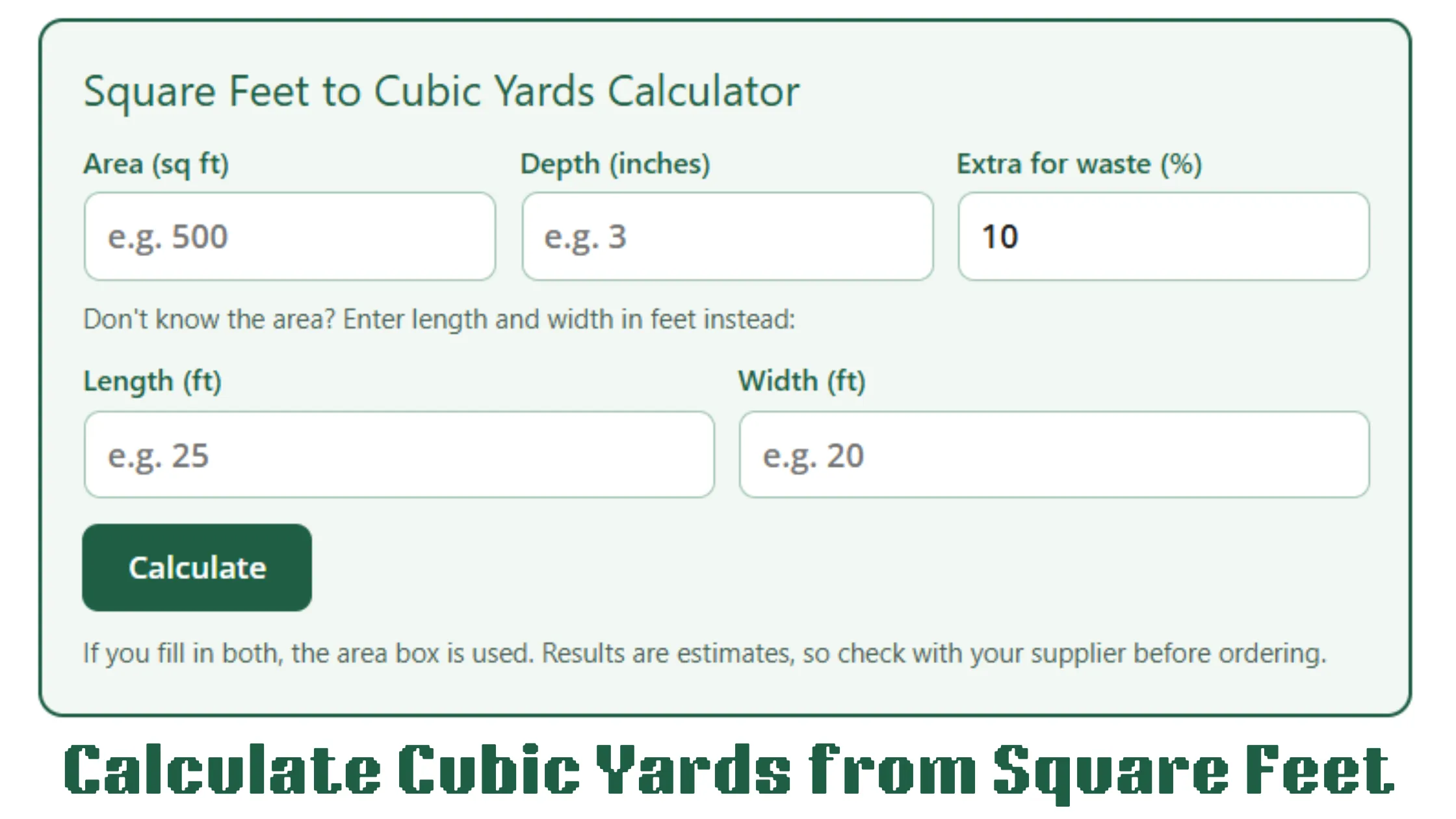
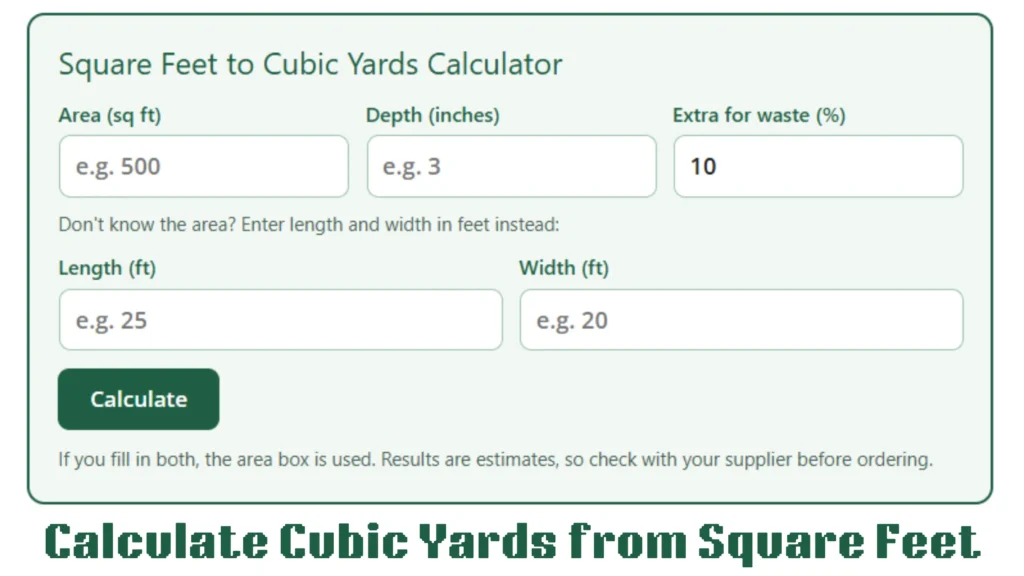
Square Feet to Cubic Yards Calculator
Don’t know the area? Enter length and width in feet instead:
| Area used | |
| Cubic yards (exact) | |
| Cubic feet | |
| Cubic metres |
If you fill in both, the area box is used. Results are estimates, so check with your supplier before ordering.
WHY SQUARE FEET ALONE IS NOT ENOUGH
Square feet tell you how much ground you are covering. They say nothing about how thick the layer is. Two inches of mulch and six inches of mulch over the same 300 square feet are very different amounts of material, and the second one needs three times as much.
Cubic yards measure volume, which is length, width and height together. So to get from square feet to cubic yards you need a third number: the depth of the layer you plan to spread. Without it, no calculator on earth can give you a correct answer.
How to Calculate Cubic Yards from Square Feet
Here is the whole method in three steps.
Step 1. Convert depth from inches to feet. Divide the inches by 12. Three inches becomes 0.25 feet.
Step 2. Multiply the area by the depth in feet. This gives you cubic feet.
Step 3. Divide cubic feet by 27 to get cubic yards. There are 27 cubic feet in a cubic yard, because a cubic yard is 3 feet by 3 feet by 3 feet.
Written as one line:
Cubic yards = square feet x depth in inches / 324
The number 324 comes from multiplying 12 by 27. It saves you a step, and it is the one figure worth writing on the back of your hand if you do this kind of job often.
WORKED EXAMPLES
Example 1: Mulch for flower beds
Your beds add up to 350 square feet and you want a 2 inch layer.
350 x 2 = 700. Then 700 / 324 = 2.16 cubic yards.
Add a little extra and you would order about 2.5 cubic yards.
Example 2: Gravel driveway
Your drive is 25 feet long and 10 feet wide, so the area is 250 square feet. You want a 4 inch base.
250 x 4 = 1,000. Then 1,000 / 324 = 3.09 cubic yards.
Gravel packs down under tyres, so most people order 3.5 cubic yards for this job.
Example 3: Topsoil for a lawn
You are reseeding 1,000 square feet and want 4 inches of topsoil.
1,000 x 4 = 4,000. Then 4,000 / 324 = 12.35 cubic yards.
That is a big pile. At this size it is worth asking the supplier whether they sell by the truckload, since a full tandem load is often cheaper per yard than several small ones.
Example 4: Concrete patio
A patio 12 feet by 15 feet gives 180 square feet. You want it 4 inches thick.
180 x 4 = 720. Then 720 / 324 = 2.22 cubic yards.
Concrete is the one material where running short hurts most, because you cannot top it up later without a visible join. Order at least 10 percent more, so about 2.5 cubic yards.
QUICK REFERENCE TABLE
This table shows how many cubic yards you need for every 100 square feet at common depths. Multiply the number by however many hundreds of square feet you have.
Depth: 1 inch = 0.31 cubic yards
Depth: 2 inches = 0.62 cubic yards
Depth: 3 inches = 0.93 cubic yards
Depth: 4 inches = 1.23 cubic yards
Depth: 6 inches = 1.85 cubic yards
Depth: 12 inches = 3.70 cubic yards
So if you have 800 square feet and want 3 inches, that is 8 x 0.93 = 7.44 cubic yards. It matches what the full formula gives (800 x 3 / 324 = 7.41), with a tiny difference from rounding.
HOW TO MEASURE YOUR AREA
Most mistakes happen here, before any maths starts. A few tips from people who have done this plenty of times.
Rectangles are easy. Multiply length by width, both in feet. A bed 18 feet long and 6 feet wide is 108 square feet.
Circles take one extra step. Measure from the centre to the edge to get the radius. Multiply the radius by itself, then by 3.14. A round bed with a 6 foot radius is 6 x 6 x 3.14 = 113 square feet.
Triangles are half of a rectangle. Multiply the base by the height, then divide by 2.
Odd shapes should be split up. Break the space into rectangles, circles and triangles, work out each one, and add them together. A garden shaped like the letter L is just two rectangles. Do not try to estimate a messy shape by eye, because the error is usually bigger than you expect.
If your measurements are in yards or metres, convert them to feet first. One yard is 3 feet and one metre is about 3.28 feet.
THE DEPTH QUESTION
Choosing the right depth is as important as measuring the area. Here are the ranges people usually work with.
Mulch: 2 to 3 inches. Less than 2 and weeds push through. More than 3 can suffocate roots.
Topsoil for a new lawn: 4 to 6 inches.
Topsoil for a thin top dressing on an existing lawn: half an inch to 1 inch.
Gravel for a path: 2 to 3 inches.
Gravel for a driveway: 4 to 6 inches, usually in layers of different stone sizes.
Sand under pavers: about 1 inch, on top of a compacted base.
Concrete slab for a patio or walkway: 4 inches. Driveways and garage floors are usually thicker, often 5 to 6 inches.
These are common starting points, not rules. Local conditions, soil type and the load the surface will carry can change them. If you are building something structural, ask a professional.
ALLOW FOR WASTE AND SETTLING
The formula gives you the exact volume of an empty, perfectly flat space. Real jobs are never that tidy. Material gets spilled, ground has dips, and loose stone or soil compacts once it is walked on or rained on.
A sensible allowance is 5 to 10 percent for mulch and stone, and 10 percent for concrete. If the ground is very uneven or you are filling over soft soil, go closer to 15 percent. The calculator above has an extra percentage box for exactly this, set to 10 by default.
Ordering a bit extra costs very little compared with paying a second delivery charge. Leftover mulch or soil is easy to use somewhere else. Leftover wet concrete is not.
COMMON MISTAKES
Using inches in the multiplication. If you multiply square feet by inches and divide by 27, your answer will be twelve times too big. Either convert inches to feet first or use the 324 shortcut.
Forgetting that bags are not cubic yards. A standard bag of mulch or soil is often 2 cubic feet. You need 13.5 of them to make a single cubic yard. Check the bag size before you compare prices.
Measuring the wrong space. If you are planting around a tree or a pond, subtract that area. People often measure the whole bed and then wonder why they have too much.
Mixing up cubic yards and square yards. Turf and carpet use square yards. Bulk materials use cubic yards. They sound alike but measure completely different things.
Not asking about minimum orders. Many suppliers have a minimum delivery size, often half a yard or one yard. For a very small job, bags from a hardware store may be cheaper.
WHAT ABOUT WEIGHT?
Some suppliers sell stone and soil by the ton. As a rough guide, a cubic yard of gravel weighs around 1.2 to 1.5 tons, dry topsoil around 1 to 1.3 tons, and mulch much less, often under half a ton. Wet material weighs more. Ask your supplier for their own figure, since it varies by product and region.
Once you know the cubic yards you need, you can multiply by the supplier’s weight per yard to see roughly how many tons will arrive.
A FEW STRAIGHT ANSWERS BEFORE YOU ORDER
If your total comes out as something like 4.63 cubic yards, do not worry about the decimals. Round up to the next half yard, so 5. Suppliers rarely sell in finer steps, and a small surplus is better than a small shortage.
If your answer seems huge, check your depth. The most common cause of a wildly high result is typing 30 instead of 3, or entering feet where inches were asked for.
And if you are working on anything that bears weight, such as a slab, a retaining wall base or a driveway, treat the calculator as a planning tool and have the final numbers checked by whoever is doing the work.
FREQUENTLY ASKED QUESTIONS
1. How many square feet does one cubic yard cover?
It depends on the depth. At 1 inch deep, one cubic yard covers 324 square feet. At 3 inches it covers 108 square feet, and at 6 inches it covers 54 square feet.
2. What is the formula to convert square feet to cubic yards?
Multiply the area in square feet by the depth in inches, then divide by 324. For example, 500 square feet at 3 inches deep is 500 x 3 / 324, which is about 4.63 cubic yards.
3. How many cubic yards are in 1,000 square feet?
That depends on depth. At 2 inches you need about 6.17 cubic yards, at 3 inches about 9.26, and at 4 inches about 12.35.
4. Should I add extra when ordering?
Yes. Add 5 to 10 percent for mulch, soil and gravel to cover settling and spillage, and about 10 percent for concrete.