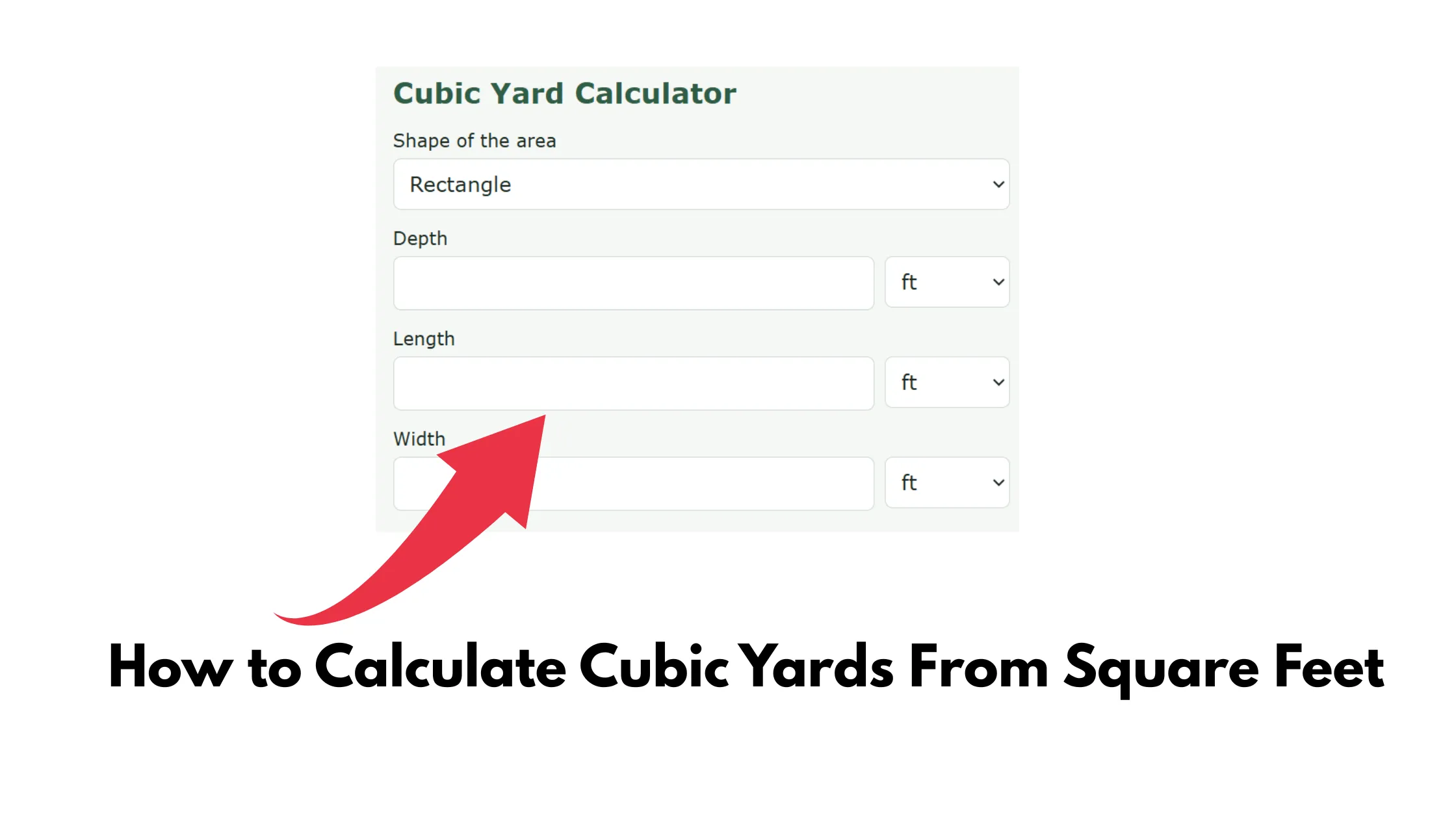
How to Calculate Cubic Yards From Square Feet: Maybe you already know your lawn is 1,000 square feet, or the patio plans say 240 square feet. Now you need to turn that into cubic yards so you can order. There’s one missing piece, and it’s depth.
Square feet measure a flat surface. Cubic yards measure a volume. To go from one to the other, you have to say how thick the layer will be. Once you do, the math is quick.
The formula
Square feet × Depth (in feet) ÷ 27 = cubic yards
Depth is usually given in inches, so divide by 12 first. A 3 inch layer is 0.25 feet.
There’s also a shortcut that skips the conversion:
Square feet × Depth (in inches) ÷ 324 = cubic yards
Where does 324 come from? One cubic yard is 27 cubic feet, and 27 × 12 = 324. So one cubic yard spreads over 324 square feet at a depth of 1 inch.
Worked examples
Mulch bed: 250 square feet, 3 inches deep.
250 × 3 ÷ 324 = 2.31 cubic yards
Lawn topsoil: 1,000 square feet, 4 inches deep.
1,000 × 4 ÷ 324 = 12.35 cubic yards
Gravel path: 60 square feet, 2 inches deep.
60 × 2 ÷ 324 = 0.37 cubic yards
The first two examples come out the same with the longer formula too. For the mulch bed: 250 × 0.25 = 62.5 cubic feet, and 62.5 ÷ 27 = 2.31.
Coverage chart: how far does one cubic yard go?
This is handy if you’re comparing prices or just want a quick gut check.
| Depth | Area covered by 1 cubic yard |
|---|---|
| 1 inch | 324 sq ft |
| 2 inches | 162 sq ft |
| 3 inches | 108 sq ft |
| 4 inches | 81 sq ft |
| 6 inches | 54 sq ft |
| 12 inches | 27 sq ft |
So if you need to cover 500 square feet with 3 inches of mulch, divide 500 by 108 and you get about 4.6 cubic yards.
Which depth should you use?
It depends on the material and the job. These are common starting points, but follow the instructions for your specific product.
- Mulch: 2 to 3 inches
- Topsoil for a new lawn: 4 to 6 inches
- Gravel walkway: 2 to 3 inches
- Gravel driveway base: 4 to 6 inches
- Sand under pavers: about 1 inch
- Garden bed fill: 8 to 12 inches
Getting the square footage right
For rectangles, multiply length by width. For a circle, use 3.14 × radius × radius. For a strange shape, break it into smaller rectangles and triangles, then add the areas together. If you’ve got a flower bed with curves, a rough estimate is fine, since you’ll be adding a buffer anyway.
A note on ‘cubic yards to square feet’
People often search for a way to convert cubic yards straight to square feet. It doesn’t work that way, because the units measure different things. What you can do is use the chart above and say, ‘One cubic yard covers 108 square feet at 3 inches deep.’ That’s the closest thing to a conversion.
Subtracting the parts you won’t cover
Most yards have things in the way: a patio, a shed, a vegetable plot. Measure the whole area, then subtract those spots.
Say your backyard is 40 feet by 50 feet, which is 2,000 square feet. A 12 × 15 foot patio takes up 180, and an 8 × 10 foot shed pad takes up 80.
- Area to cover: 2,000 − 180 − 80 = 1,740 square feet
- Topsoil at 4 inches: 1,740 × 4 ÷ 324 = 21.5 cubic yards
- With 10 percent extra: about 23.6 cubic yards
That’s a big order, so it’s worth taking ten minutes to get the area right.
When your plan isn’t in square feet
Plans and quotes don’t always use feet. These conversions save you a trip to a search engine:
- Square meters to square feet: multiply by 10.764
- Square yards to square feet: multiply by 9
- Centimeters to inches: divide by 2.54
A 60 square meter lawn is about 646 square feet. A 10 cm layer is just under 4 inches, so you can treat it as 4.
Same area, different depth
Depth changes the answer more than most people expect. Here’s a 500 square foot area at several depths:
| Depth | Cubic yards for 500 sq ft |
|---|---|
| 1 inch | 1.54 |
| 2 inches | 3.09 |
| 3 inches | 4.63 |
| 4 inches | 6.17 |
| 6 inches | 9.26 |
Going from 3 inches to 4 adds more than a yard and a half. Decide on the depth before you ask for a price.
Bulk or bags: a real comparison
Take the 250 square foot mulch bed at 3 inches, which needs 2.31 cubic yards. That’s about 62 cubic feet.
- Bags: with 2 cubic foot bags, you need 32 bags. At $4 a bag, that’s $128.
- Bulk: at $40 per cubic yard, 2.31 yards costs about $92, plus delivery.
Prices vary a lot by area, so check your local numbers. In general, bulk wins once you need more than a yard, as long as the delivery fee isn’t high.
Slopes and curves
For a gentle slope, measure the flat footprint and don’t worry. Your buffer covers the small difference. On a steep bank, measure along the slope, because the surface you’re covering is bigger than the flat footprint.
For curved beds, a rough estimate is fine. Split the shape into a rectangle and a half circle, or just measure the widest and narrowest points and average them.
What if the supplier sells by weight?
Some yards price gravel and soil by the ton. Once you have cubic yards, multiply by the density. These are typical ranges, and your supplier can give you the exact figure:
- Mulch: 0.3 to 0.5 tons per cubic yard
- Topsoil: 1.0 to 1.4 tons
- Gravel: 1.3 to 1.7 tons
The 500 square foot area at 3 inches needs 4.63 cubic yards. If you fill it with gravel, that’s roughly 6 to 8 tons. The same area of mulch is about 1.4 to 2.3 tons.
Add a buffer
Add 5 to 10 percent for most jobs, and up to 15 percent for loose material that will compact, like gravel or topsoil. If the 250 square foot mulch bed needs 2.31 yards, ordering 2.5 is sensible.
Skip the arithmetic
If you’d like to double-check your number, our calculator has a Known Area option. Enter the square feet, add the depth, and it gives you cubic yards, cubic feet and cubic meters.
More Tools: Cubic Yards to Yards Calculator
2 thoughts on “How to Calculate Cubic Yards From Square Feet”