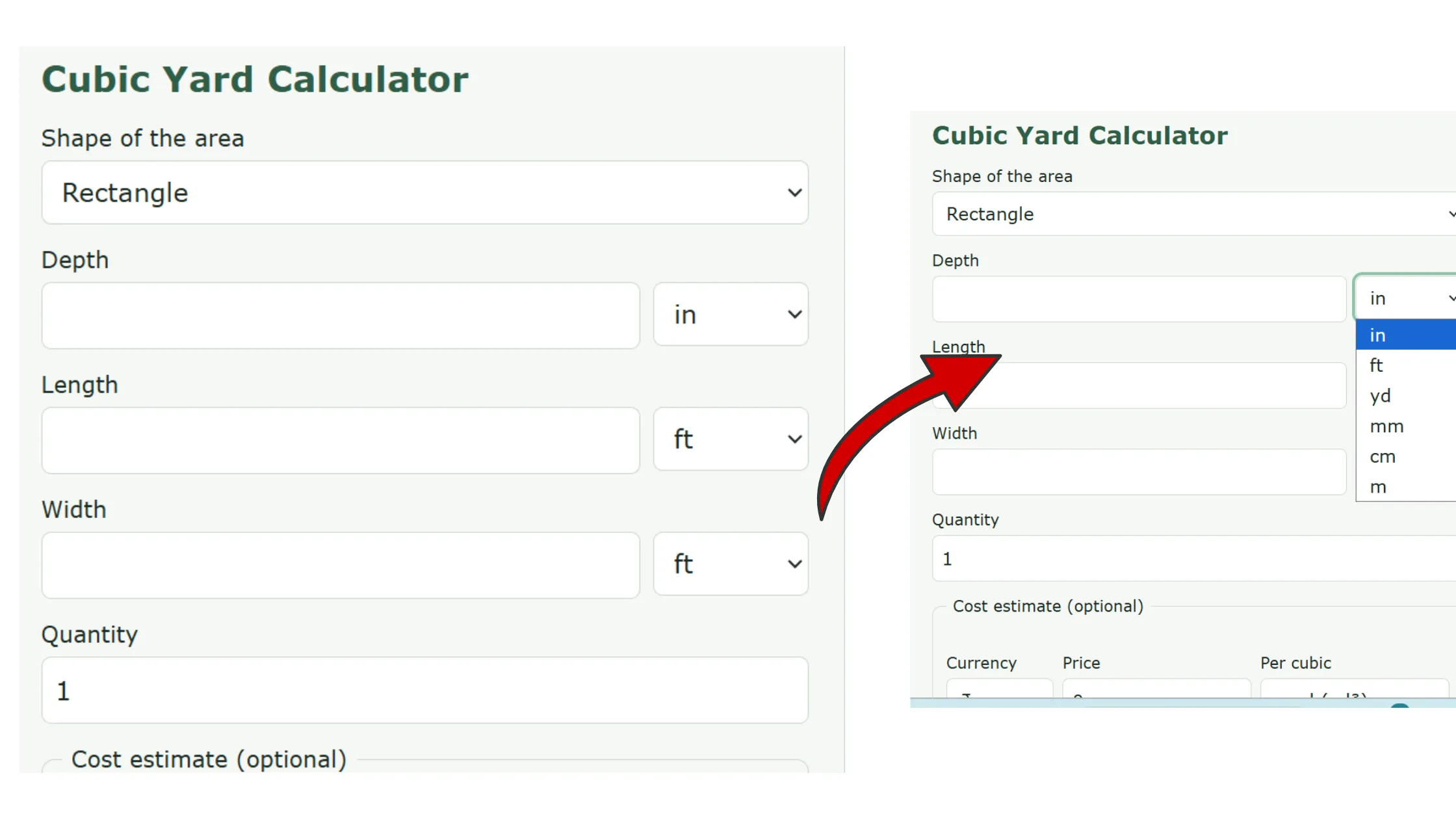
How to Calculate Cubic Yards: You call the supplier to order gravel, and the first thing they ask is, ‘How many yards do you need?’ If you freeze up at that point, you’re not alone. Most people measure in feet and inches, but materials are sold by the cubic yard. The good news is that the math takes about a minute once you know the trick.
This guide shows you how to calculate cubic yards by hand, with real examples you can copy. If you’d rather skip the math, the cubic yard calculator on our homepage does it for you.
What a cubic yard actually is
Picture a cube that is 3 feet wide, 3 feet long and 3 feet tall. The space inside it is one cubic yard. Since 3 × 3 × 3 = 27, one cubic yard equals 27 cubic feet.
A few conversions worth keeping handy:
- 1 cubic yard = 27 cubic feet
- 1 cubic yard = 0.765 cubic meters
- 1 cubic meter = 1.308 cubic yards
The formula
The formula for cubic yards is:
Length (ft) × Width (ft) × Depth (ft) ÷ 27 = cubic yards
Multiply the three measurements to get cubic feet, then divide by 27. That’s all of it.
Step by step
- Measure the length and width of the space in feet.
- Measure the depth. This is usually in inches, so divide by 12 to turn it into feet. Four inches is 0.33 feet, six inches is 0.5 feet.
- Multiply length × width × depth.
- Divide the answer by 27.
- Round up to the next quarter or half yard, because that’s how most suppliers deliver.
Example: a raised garden bed
Your bed is 8 feet long, 4 feet wide and 10 inches deep.
- Depth: 10 ÷ 12 = 0.83 ft
- Volume: 8 × 4 × 0.83 = 26.6 cubic feet
- Cubic yards: 26.6 ÷ 27 = 0.99
So you need about one cubic yard of soil. Because soil settles after the first watering, ordering 1.1 is a safer bet.
What if the area isn’t a rectangle?
Most yards aren’t perfect boxes. Here’s how to handle other shapes. Find the flat area first, then multiply by depth and divide by 27.
- Circle: area = 3.14 × radius × radius. For a 10 ft wide circle, the radius is 5, so the area is about 78.5 square feet.
- Triangle: area = base × height ÷ 2.
- L-shapes and odd shapes: split them into rectangles, work out each one, and add the results.
Example: a round fire pit area, 10 feet across, covered with 3 inches of gravel.
78.5 × 0.25 ÷ 27 = 0.73 cubic yards
Working in metric
If you measure in meters, multiply length × width × depth to get cubic meters, then multiply by 1.308 to get cubic yards. A 5 m × 3 m area filled 0.1 m deep is 1.5 cubic meters, which is about 1.96 cubic yards.
Inches to feet: a cheat sheet
Depth is where most people trip. Keep this table nearby when you measure:
| Inches | Feet |
|---|---|
| 1 | 0.083 |
| 2 | 0.167 |
| 3 | 0.25 |
| 4 | 0.33 |
| 6 | 0.5 |
| 8 | 0.67 |
| 12 | 1.0 |
A second example: a gravel path
Say you want a path that’s 40 feet long and 3 feet wide, covered with 3 inches of gravel.
- Depth: 3 ÷ 12 = 0.25 ft
- Volume: 40 × 3 × 0.25 = 30 cubic feet
- Cubic yards: 30 ÷ 27 = 1.11
Gravel packs down once people start walking on it, so add about 10 percent and order roughly 1.25 cubic yards.
What to do when the ground isn’t level
Real ground has dips and humps. Don’t measure the depth in one spot and hope for the best. Take four or five readings across the area, then average them.
Say you measure 2, 3, 5 and 4 inches. Add them up (14) and divide by 4, and you get 3.5 inches, or about 0.29 feet. Use that number as your depth. For a very bumpy yard, take more readings. It takes a few extra minutes and saves you from a bad guess.
Adding up more than one area
A typical weekend project has several pieces: a bed here, a path there. Work out each one on its own, write the cubic yards next to it, and add them up at the end.
| Area | Cubic yards |
|---|---|
| Front flower bed | 0.80 |
| Gravel path | 1.11 |
| Raised bed | 0.99 |
| Total | 2.90 |
Add your buffer to the total, not to every line. It’s one less thing to calculate.
Bags or bulk?
Suppliers sell bulk material by the cubic yard, but bags are labeled in cubic feet. Since a yard is 27 cubic feet, the conversion is easy:
- 1 cubic foot bags: 27 per cubic yard
- 2 cubic foot bags: 13.5 per cubic yard
- 3 cubic foot bags: 9 per cubic yard
For small jobs, bags are fine. Once you pass a yard or so, bulk delivery is usually cheaper and a lot less lifting.
Does your answer pass the sniff test?
A quick check can catch a typo before it costs you money.
- One cubic yard covers about 324 square feet at 1 inch deep. If your area is 324 square feet and 1 inch deep, you should get about 1.
- If the answer looks like a mountain for a small flower bed, you probably forgot to divide the depth by 12. That mistake makes the result 12 times too big.
- A full-size pickup bed holds roughly 1.5 to 2 cubic yards of loose material when filled level. If you need 6 yards, you’re looking at several trips or a delivery.
Hand math or calculator?
Doing it by hand is fine for one rectangle. Once you’ve got circles, triangles, several areas and a price to compare, a calculator is faster and cuts down on slips. Ours lets you pick the shape, switch units and add a price per yard to see the cost. Try your own math first, then use the calculator as a second opinion.
Don’t forget extra material
Nobody’s measuring is perfect, and the ground is rarely flat. Add 5 to 10 percent to your final number. For gravel and fill that will be compacted, add 10 to 15 percent. Running short means paying a second delivery fee and sometimes getting a slightly different color or batch.
Mistakes that cost people money
- Mixing units. Feet for length and width, inches for depth, with no conversion. This one causes most of the wrong answers.
- Skipping the depth. Square footage alone can’t tell you how much material fills a space.
- Rounding down. Round up. Leftover material is easy to use. Missing material is a headache.
Quick recap
Measure in feet, multiply length by width by depth, divide by 27, and add a little extra. Once you’ve done it twice it will feel automatic. For a faster answer with any shape, try our free calculator at the top of the homepage.
1 thought on “How to Calculate Cubic Yards (Simple Steps and Examples)”